
Creating the Spark
How my practice as an artist and craftsman shows up in my coaching

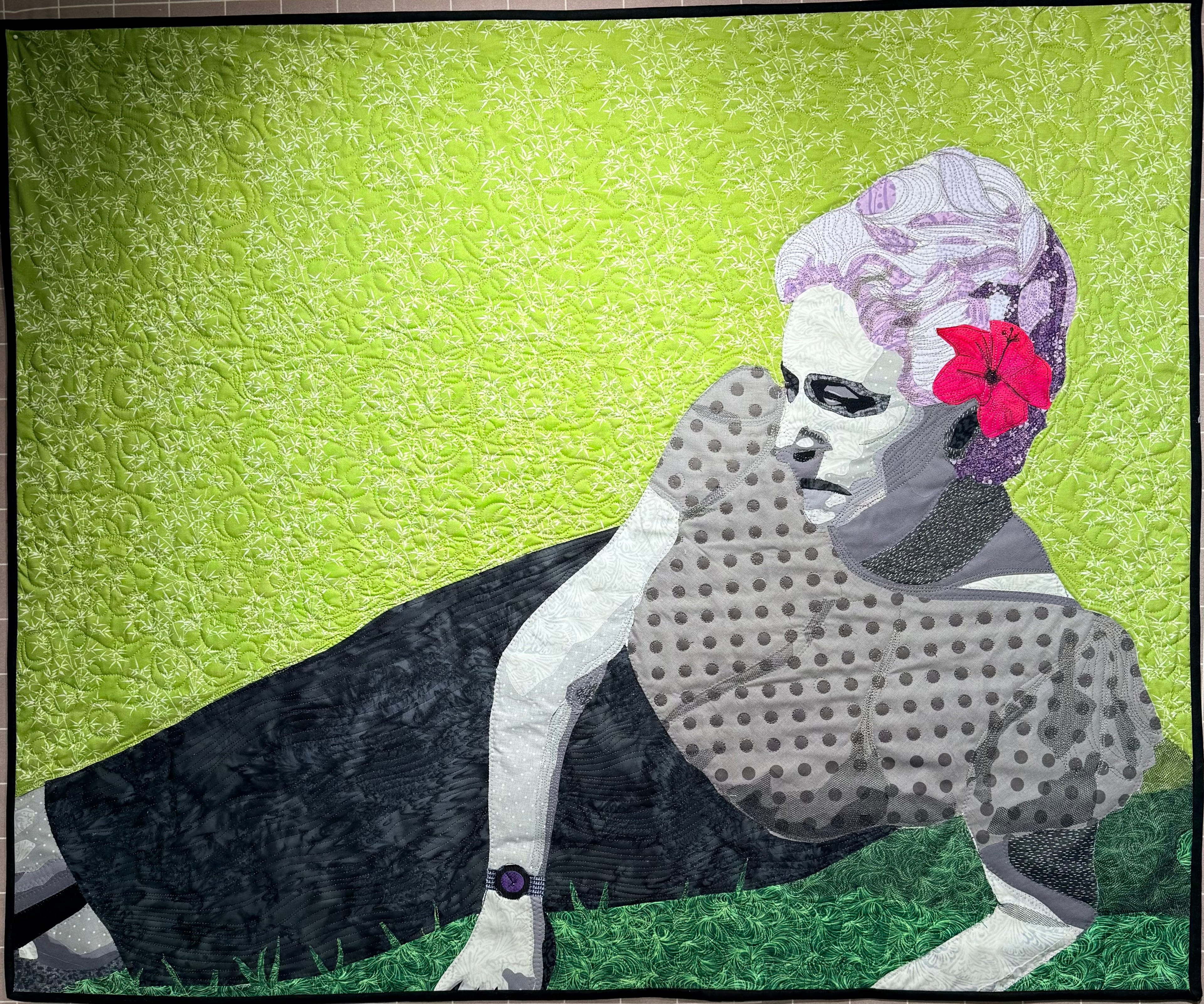
“Shoshana” by Josh Chernoff (2026)
Some of you may know that, in addition to professional coaching, I spend a meaningful part of my life making things.
I quilt. I sew. I have been actively creating things for the past 40 years or so. I work with color, texture, line, proportion, and form. I take photographs and translate them into fabric. I experiment with unfamiliar materials and a variety of sewing tools and machines. Sometimes I begin with a clear picture of what I want to make. Other times, I start with a fragment of an idea and discover the work as I make it. I have trained myself not to be afraid to fail at some artistic endeavor because I know I always learn something, that something unexpected and fundamentally good will emerge despite myself.
This practice as an artist and craftsman shows up in my coaching more than I once realized.
Not because I consider myself a creativity coach. Some coaches specialize in helping artists, designers, writers, and organizations become more innovative. That is not how I define my practice.
Instead, I borrow from my art practice to create a spark with my clients: a disruption of their usual way of thinking, an unexpected question, a new metaphor, or an invitation to see the familiar from another angle.
This approach is rooted in one of the principles that first drew me to the Co-Active coaching methodology: the belief that people are naturally creative, resourceful, and whole.
The word creative mattered deeply to me.
Creativity Is Not a Special Talent
Many people have a narrow definition of creativity. They associate it with painting, music, writing, performance, or some other recognizable artistic practice. Under that definition, people are divided into two groups: creative people and everyone else.
But creativity is not limited to making art. Read Rick Rubin’s masterful book The Creative Act: A Way of Being if you have more curiosity about creativity in its broadest context.
Creativity is the capacity to imagine something that does not yet exist—and then begin moving toward it.
A leader redesigning a team is being creative. A person trying to have a different kind of conversation with a boss is being creative. An executive imagining a career beyond the path that has always been expected of her is being creative. So is someone developing a new response to conflict, reconsidering an old assumption, or finding a way to act despite uncertainty.
Every coaching engagement contains a multitude of creative acts, large and small.
The client is attempting to bring something new into being: a new role, a new relationship, a new habit, a new understanding, or a new version of themselves.
My job is not to create that future for them. It is to help establish the conditions in which they can create it.
Beginning Before the Answer Is Clear
When I begin a piece of art, I often do not know exactly where it will end.
I may have a photograph, a sketch, a piece of fabric, or an idea about scale. I make an initial choice and then respond to what happens. One color changes how another color appears. A line that looked right in the sketch feels wrong when enlarged. A technical limitation becomes an invitation to try something I had not originally considered.
The work emerges through an exchange between intention and discovery.
Coaching often works the same way.
Clients sometimes believe they should arrive with a fully formed goal. They want to know the answer before they begin. They may hesitate to move until they can see the entire path.
But meaningful change rarely unfolds that neatly.
We begin with what is known. We make an observation. We test an interpretation. We imagine a possibility. We take a small action and learn from the result.
This is not indecision. It is a creative process.
A coach can help clients become more comfortable working with an incomplete picture—not recklessly, but experimentally. Instead of asking, “What is the perfect decision?” we might ask, “What could you try that would teach you something?”
That question shifts the client from solving to creating.
Working With the Material That Is Present
A craftsman develops respect for materials.
Fabric has a “hand” – the way it feels, its grain, weight, elasticity, its nap. Wood has knots. Clay has moisture and memory. Every material has possibilities and limitations. Good work does not come from pretending those qualities do not exist. It comes from understanding them and working with them.
People also arrive with material.
They bring experience, strengths, relationships, fears, habits, responsibilities, contradictions, and history. They may wish some of these things were different. They may not recognize the value of the material they already have. They may believe they need to become an entirely different person before they can move forward.
The Co-Active belief that people are naturally creative, resourceful, and whole asks the coach to resist that conclusion.
Wholeness does not mean that a person has nothing to learn. Resourcefulness does not mean that every answer is immediately accessible. Creativity does not mean that change is easy.
It means that the client is not raw material waiting for the coach to shape them.
They are already a maker.
Together, we can examine what is available. What strengths have not yet been fully used? What past experiences could be reinterpreted? What relationships might become resources? What constraint might inspire a more original solution?
In art, limitations often sharpen the work. The edge of the canvas, the amount of fabric available, or the capabilities of a particular machine can force a decision. I rarely buy specific fabric for a new project. Instead, I have collected a deep library of fabrics and related materials that have in some way “spoken” to me, and I use that finite set of inputs to create a useful creative constraint that forces me to be innovative in getting the result I want. In coaching, constraints can serve a similar purpose. A limited budget, a complicated organizational structure, or a difficult stakeholder may not be obstacles that disappear. They may be part of the composition.
Learning to See Again
Artistic practice has also trained me to look more closely and more objectively.
When translating a face into fabric, for example, I have to stop seeing “a face” and begin noticing shapes. Where does the light fall? Which lines actually create the expression? What appears to be one color but is really several? What detail is essential, and what can be omitted? How can I communicate a sense of depth and proportion using only fabric and thread?
Coaching requires a similar quality of attention.
Clients naturally develop fixed descriptions of their situations:
“My boss does not trust me.”
“I am not good at organizational politics.”
“My career is plateauing.”
“I need to be more confident.”
“I have no choice.”
These statements may contain truth, but they are also compositions. They emphasize certain details and leave others in the background.
The coach’s role is not simply to accept the first rendering.
We can look again.
What specifically tells you that your boss does not trust you? When are you already effective at organizational politics? What would confidence look like as an observable behavior? What are your career expectations? Where might there be more choice than you initially assumed?
A useful coaching question changes the angle of the light. It allows the client to see distinctions that were previously hidden.
Sometimes that new way of seeing is the spark.
Composition, Editing, and Choice
Making art involves continual choice.
What belongs in the foreground? What should recede? Where does the eye need a place to rest? What adds energy? What creates confusion? What needs to be removed, even though I worked hard to make it?
Leadership requires composition, too.
A leader cannot give every issue equal weight. A professional life cannot contain every possible ambition at the same intensity. A person cannot say yes to every opportunity without obscuring what matters most.
Coaching helps clients compose.
We consider what belongs at the center and what has occupied too much space. We identify what needs greater contrast and what has become visual noise. We ask whether the different pieces of a life or leadership practice form something coherent.
And sometimes we edit.
Artists learn that effort alone does not justify keeping something in the work. Leaders and professionals face the same challenge. A responsibility, identity, goal, or way of working may once have served a purpose. That does not mean it must remain forever.
Creating something new frequently requires making room.
The Courage to Make an Awkward First Attempt
Perhaps the most useful lesson from making things is that creativity requires tolerance for imperfection.
The first sketch may be clumsy. The first seam may need to be removed (over time, I have learned that the seam ripper is my friend). A technique that looked simple in someone else’s hands may prove frustrating in mine. At some point, I have to risk making something that does not yet match my aspiration.
Clients face that moment too.
The first boundary-setting conversation may feel unnatural. A new leadership behavior may seem overly deliberate. A person practicing greater visibility may initially feel self-conscious. Someone learning to delegate may do it inelegantly before doing it well.
We often interpret awkwardness as evidence that a new behavior is inauthentic.
But awkwardness may simply be evidence that it is new.
An artist does not abandon the work because the first attempt fails to express the full idea. The artist studies what happened, adjusts, and tries again. Why did the eyes look so real, so alive, in the prior portrait, but don’t carry that spark in this one?
Coaching can create a place where clients develop that same patience with themselves.
The Client as Creator
My artistic practice influences the questions I ask, the metaphors I use, and the experiments I invite clients to undertake. It reminds me that discovery does not always follow a straight line and that an unexpected result may contain information rather than failure.
Most importantly, it reinforces my belief in the client as creator.
The coach may help prepare the studio. We may adjust the light, introduce a tool, point toward an overlooked possibility, or ask what the client is trying to make.
But we do not take the work out of their hands.
The future being created belongs to them.
And sometimes, in the space between a familiar problem and an unfamiliar question, a spark appears. The client sees a possibility that was not visible before.
That moment is creative.
And everyone is capable of it.
Excellent piece. I've found that the way I look at the world has changed thru my very beginning drawing/painting practice. I really appreciate your thoughts on how that applies to coaching and moving in new ways.
I love this piece.